
We Mapped Where Detained Immigrants Can Still Get a Bond Hearing
Same arrest. Same facts. A completely different outcome depending on which state you are detained in.
This post is general information, not legal advice.
 >
>If ICE arrests someone inside the United States, the first question almost every family asks is the same one: how do we get them out? For years, the answer usually started with a bond hearing — a chance to stand in front of an immigration judge and ask to be released while the case plays out.
In 2025 the government began arguing that many people arrested in the interior are not entitled to that hearing at all. The fight comes down to two statutes. One of them, Section 1226, lets an immigration judge set bond. The other, Section 1225, covers people “seeking admission” at the border and requires detention with no bond hearing. The administration’s position is that almost anyone who entered without inspection — even someone who has lived here for a decade, with a job and U.S. citizen children — is still “seeking admission” and can be held with no hearing.
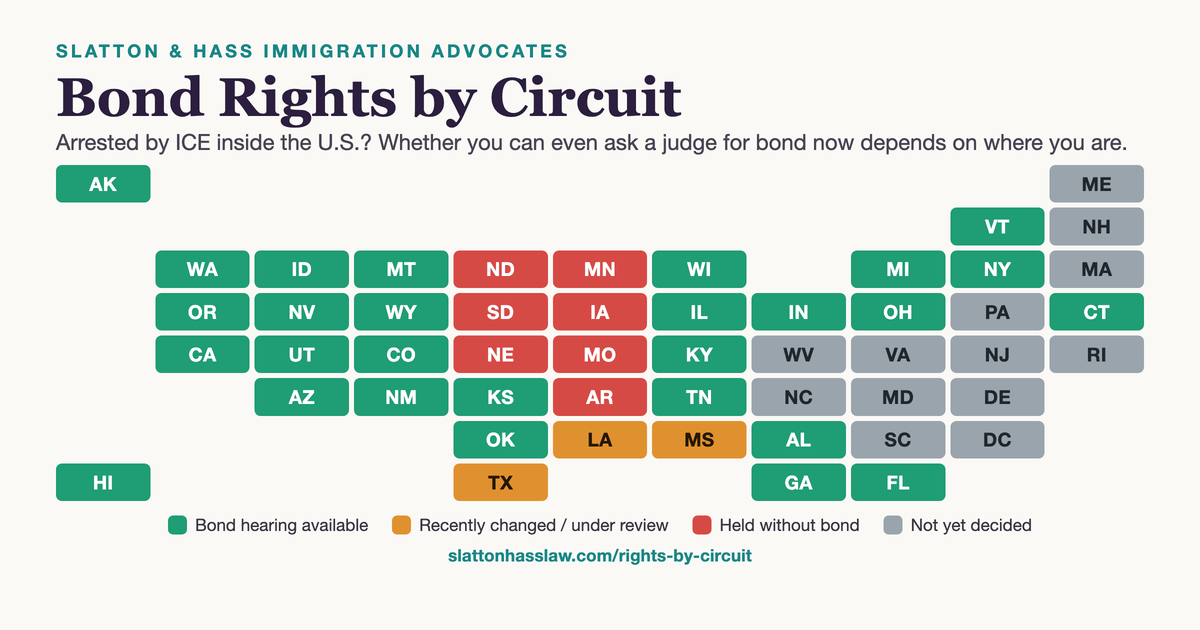
The federal appeals courts have split hard over whether that is legal, and that is where geography takes over. Six circuits — the Second, Sixth, Seventh, Ninth, Tenth, and Eleventh — have rejected the no-bond policy. If you are detained in those states, you can generally still ask a judge for bond. The Eighth Circuit went the other way and upheld detention without a hearing for people arrested in the interior. And several circuits — the First, Third, Fourth, and D.C. — have not issued a binding ruling yet, so outcomes there can turn on your local court.
Then there is the Fifth Circuit — Texas, Louisiana, and Mississippi — which just whipsawed. In early July 2026 a three-judge panel ruled that long-time residents must receive a bond hearing within 90 days. Days later, the full Fifth Circuit voted to rehear the case, which automatically vacated that decision. So for now the no-bond policy is back in effect there, with argument before the full court expected this fall. If your strategy in Texas feels like it changed overnight, that is why — and it is the clearest sign of how fast this is all moving.
See where your circuit stands. That whiplash is exactly why we built this as a living map instead of a post that goes stale in a week. On Bond Rights by Circuit you can tap your state and see where things stand right now: green means a bond hearing is available, red means detention without bond, amber means a ruling recently changed and is under review (like the Fifth Circuit), and gray means no binding ruling yet.
A few honest caveats. This corner of immigration law is moving faster than almost anything else right now, and the map reflects the most recent update we have made — nothing more. A decision can be stayed, reheard, or reversed the week after we publish. In June 2026 the government asked the U.S. Supreme Court to allow no-bond detention nationwide, which could eventually replace this entire patchwork with a single rule. And even where a bond hearing is available, release is never automatic; a judge still weighs flight risk and safety.
None of this is legal advice, and every case turns on its own facts. But if someone you love is detained, you should not have to guess what the rules are in the place they happen to be held. If you are trying to get a family member released, we can help you figure out what is actually possible in your circuit — reach our team any time on our 24-hour detention line at 240-891-4343, or book a consultation below.
Slatton & Hass Immigration Advocates is a Maryland-based immigration firm handling detention, bond, and habeas cases. This post is general information, not legal advice, and does not create an attorney-client relationship.