
DACA Is Not a Shield: What the BIA's Landmark Ruling Means for 500,000 Dreamers
For more than a decade, hundreds of thousands of immigrants raised in the United States operated under a critical assumption: that their DACA status would, at minimum, pause any effort to remove them. A ruling issued Friday by the Board of Immigration Appeals (BIA) has shattered that assumption.
The case began at an airport. On August 3, 2025, Catalina "Xóchitl" Santiago, an immigration rights advocate and active DACA recipient, was detained by Customs and Border Protection officers while attempting to board a domestic flight in El Paso, Texas. She was held in immigration detention for nearly two months before a federal judge ordered her release in October. Her case wound its way through the immigration court system, and ultimately to the country's highest administrative immigration tribunal.
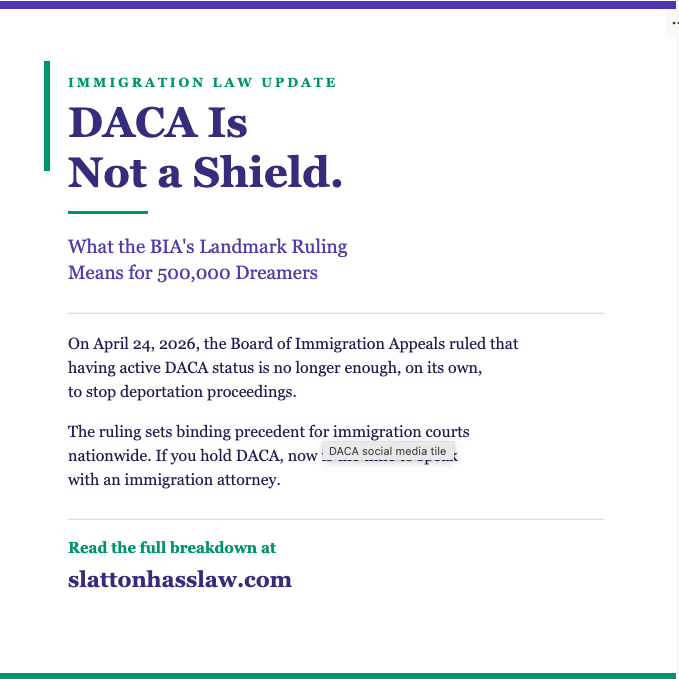
On April 24, 2026, the Board of Immigration Appeals issued its decision in Matter of Santiago-Santiago, 29 I&N Dec. 589. The consequences may reach far beyond one woman's case.
What the BIA Actually Decided
The original immigration judge had terminated Santiago's removal proceedings in September 2025. His reasoning: she held valid, unrevoked DACA protection, and federal regulations permit immigration judges to exercise "discretionary termination" of proceedings for beneficiaries of deferred action. The Department of Homeland Security appealed.
The BIA's three-judge panel found that the immigration judge had erred "in terminating removal proceedings based solely on the fact that the respondent has been accorded DACA protection and without considering the reasons for any opposition to termination." In other words: DACA alone cannot carry the day. Judges must now weigh all the factors, including the government's reasons for pursuing removal.
Because the ruling was published, it carries binding precedential weight. Every immigration judge in the country must now apply this standard when a DACA recipient asks to have their removal proceedings terminated.
The Judge Recusal Question
The ruling carried an additional, striking wrinkle. DHS had argued that the original immigration judge should have recused himself from the case, citing his marriage to Rep. Veronica Escobar of Texas, a Democratic congresswoman who had publicly advocated for Santiago. The BIA declined to rule on the recusal issue on the merits, but it took the unusual step of ordering the case reassigned to a different immigration judge to "avoid the appearance of partiality or bias and to ensure the integrity of the removal proceedings."
What This Means for the Half-Million People Who Hold DACA
The implications ripple outward immediately. Because BIA published opinions set binding precedent for immigration judges nationwide, courts across the country are now on notice: DACA status alone is not enough to end a deportation case.
Advocates warn the consequences could be severe. The decision potentially weakens protections for roughly 506,000 DACA recipients nationwide, including more than 141,000 in California alone. United We Dream called the ruling "yet another step in dismantling the program without the government taking responsibility for ending it outright. This is a quiet rollback of protections, and our communities are paying the price in real time."
For DACA recipients already in removal proceedings, or those who might be placed in them, the ruling means they can no longer rely on DACA status alone to protect them. They will need to present affirmative arguments for why their case warrants termination, and a judge must weigh the government's opposition. That is a meaningfully higher bar.
The Broader Trajectory: A BIA Moving Sharply in One Direction
This decision doesn't exist in a vacuum. According to an NPR analysis, the BIA sided with government lawyers in 97% of publicly posted cases in 2025, at least 30 percentage points above the board's average over the preceding 16 years. The board also issued 70 published, precedent-setting decisions last year, a record number.
This tracks with the Trump administration's broader posture toward DACA. Starting in 2025, DHS officials began urging recipients to self-deport, asserting that the program does not confer lawful immigration status. No regulatory action has formally ended DACA, but the administrative environment surrounding it has shifted dramatically. Nearly 300 DACA recipients were arrested in 2025 alone.
What This Decision Does Not Do
It's important to be precise about what the BIA did not hold. The ruling does not mean DACA recipients will be automatically or immediately deported. DACA recipients may still ask immigration judges to terminate their removal proceedings — that right was explicitly preserved. What changed is the standard: a judge must now engage with the government's arguments before granting termination, rather than treating DACA status as automatically dispositive.
In a narrow technical sense, this is a procedural ruling, a reminder that immigration judges must follow the framework laid out in a May 2024 regulation before dismissing a case. But the practical effect in the current enforcement climate may be far less benign.
What Comes Next
Santiago's case was remanded to a new immigration judge. She has not been ordered deported and may still present additional arguments, including a potential adjustment of status based on her marriage to a U.S. citizen.
For the half-million DACA recipients watching this case, the path forward is narrower than it was a week ago. DACA is a reprieve, not a guarantee. Those who rely on it without pursuing every available avenue toward permanent status, including marriage-based adjustment, employer sponsorship, or other pathways, do so at significant risk.
Congress has failed for more than two decades to pass a DREAM Act or any other durable legislative fix for this population. With the administrative landscape shifting this rapidly, that failure grows more consequential by the month.
The case of Catalina "Xóchitl" Santiago is not over. But the ruling that bears her name is already reshaping the legal terrain beneath hundreds of thousands of people who have spent their entire adult lives in the United States, and who now face a more uncertain future than ever before.