
I used to interview asylum seekers. This Supreme Court ruling was hard to read.
Years ago, when I was an asylum officer, I sat across a table from a ten-year-old boy who had crossed Mexico alone. I asked him how he'd done it.
He looked at me like I'd said something a little silly.
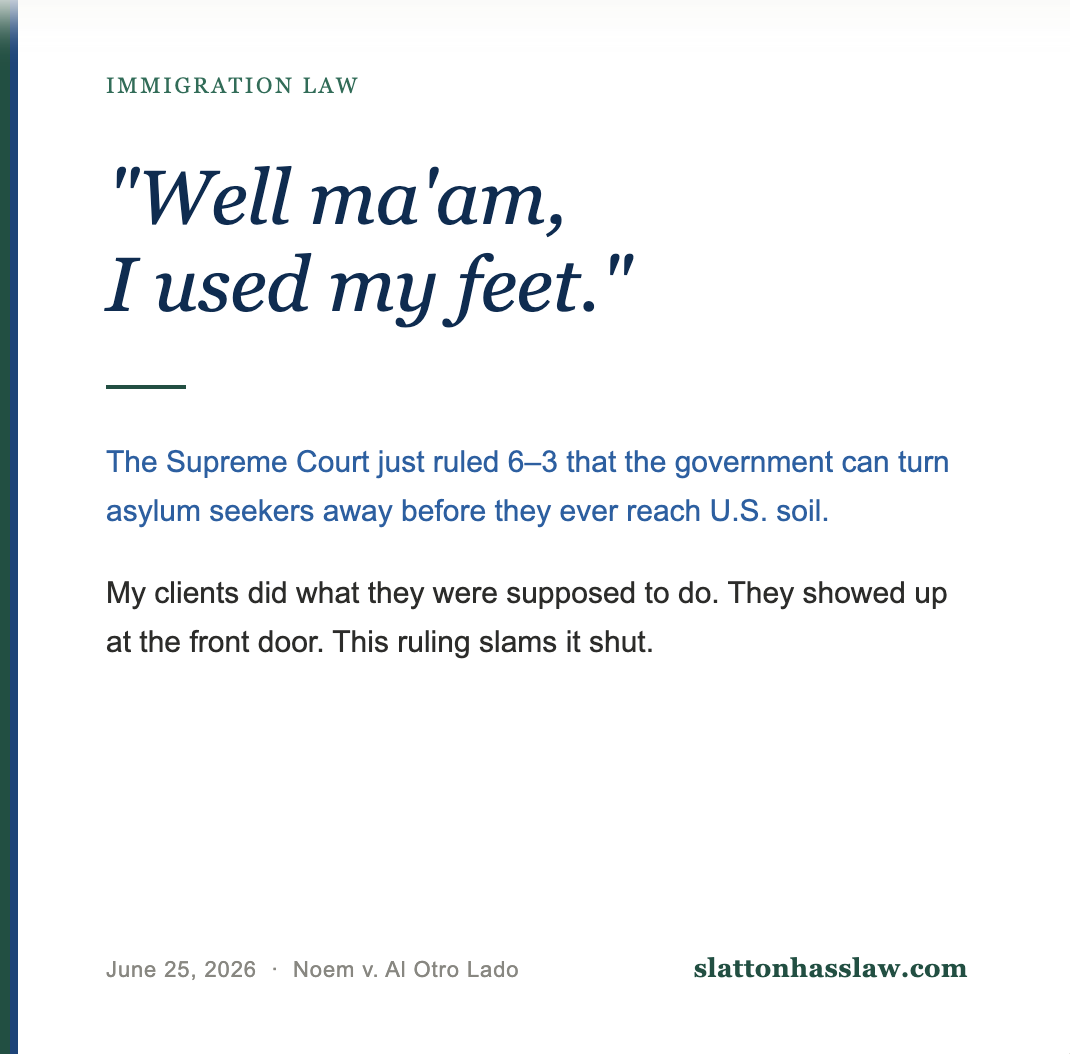
"Well ma'am, I used my feet."
We both laughed. I still think about him and everything he went through to pass safely into America. Even the bravery to tell his story to a federal officer is something a lot of us lack.
He was granted asylum. I hope he's doing well.
That interaction has stayed with me through years of immigration work, first as an officer and now as an attorney. Because what that boy did, what all of my clients do, is exactly what the law asks of them. They show up. They present themselves at the border. They go through the process.
That process isn't just about them. When someone arrives at a port of entry and asks for asylum, the government gets to run background checks. It knows who is coming in. People cross peacefully, and their cases are decided through the courts. It is orderly. It is safe. It is, in the most literal sense, the system working as designed.
What the Court decided today
Today, the Supreme Court ruled 6 to 3 in Noem v. Al Otro Lado that the government can legally turn asylum seekers away before they ever set foot in the United States. The practice is called "metering." Border agents decide a port of entry is full, and people are told to wait in Mexico. Sometimes for days. Sometimes indefinitely.
The legal question was narrow but consequential: under federal law, asylum seekers who "arrive in" the United States have the right to apply. The Court's majority decided that if you're standing on the Mexican side of a border gate, you haven't arrived. You have no rights. You can be turned away.
Justice Alito, writing for the majority, put it plainly: the law's protections simply haven't kicked in if you haven't crossed the line.
Three justices disagreed. They argued this reading makes the asylum system hollow, that Congress intended something broader, and that the United States has international obligations to people fleeing persecution that this ruling ignores.
What this means for real people
The metering policy isn't currently active. But this ruling means the government can bring it back whenever it wants, with the Supreme Court's blessing. People fleeing violence, persecution, and death will be told to wait in dangerous border cities with no timeline, no guarantee, and now no legal recourse.
My clients did things right. They came to the front door. They identified themselves. They submitted to the process. This ruling tells future asylum seekers that doing things right is no longer enough. The door itself can be closed.
I keep thinking about that ten-year-old. He crossed an entire country on foot, alone, to get to a place where he could ask for help. Under today's ruling, a border agent could have simply said no before he ever got the chance.
That's not the country I thought I was working for and this ruling hits hard.