
The Baltimore Hold Rooms: What the Court Just Ruled and Why It Matters
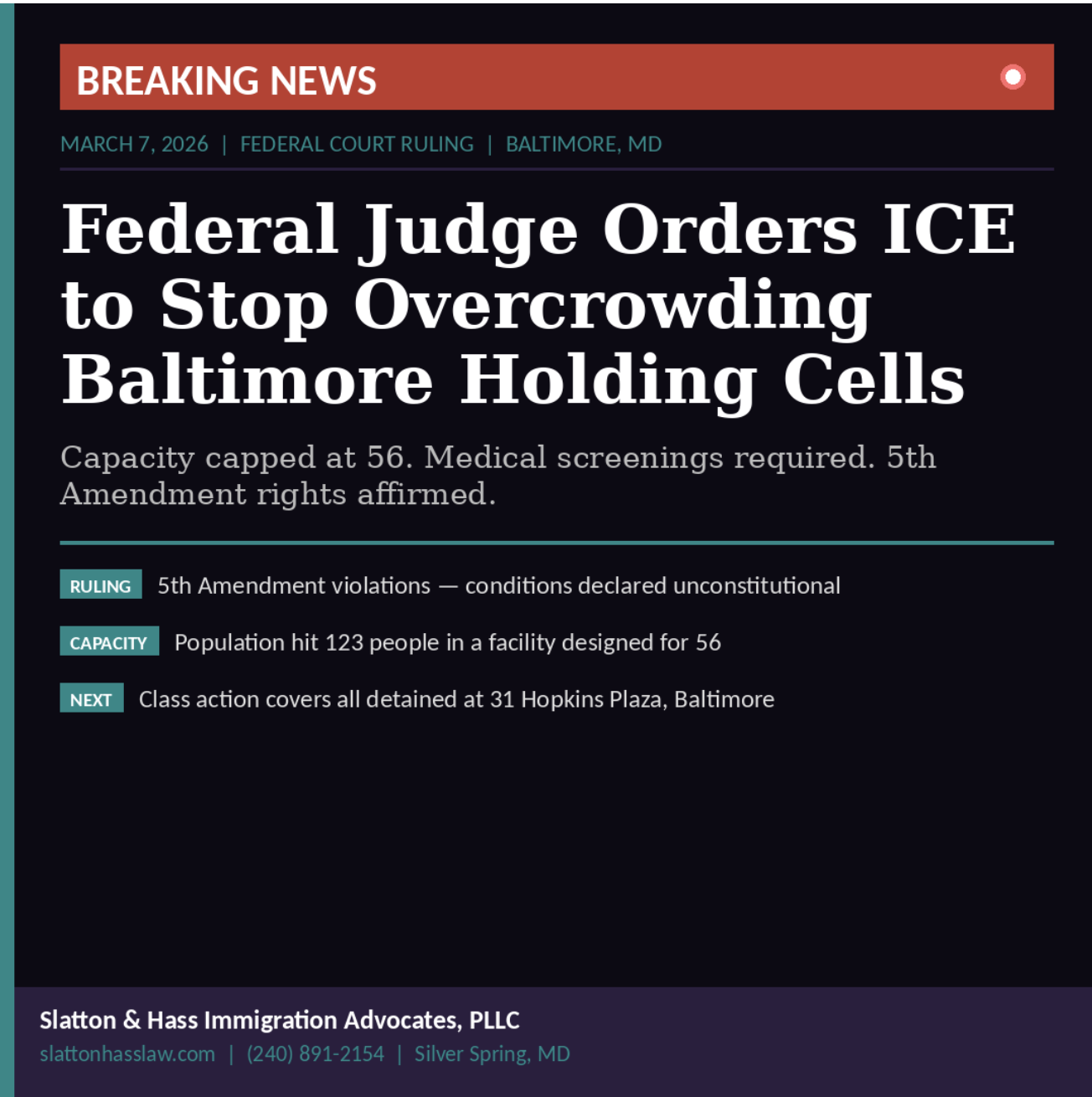
On March 7, 2026, a federal judge issued a ruling that should have been issued months ago. U.S. District Judge Julie R. Rubin ordered that ICE must immediately cap the number of people held in the Baltimore hold rooms at 56 people across five cells. That number sounds like an improvement. But the story of how we got here is one every Maryland resident and every person in this country deserves to understand.
What Are the Baltimore Hold Rooms?
Located at 31 Hopkins Plaza in downtown Baltimore, inside the George Fallon Federal Building, the ICE Baltimore field office contains a series of holding cells that are supposed to function as short-term processing space. Per ICE's own guidelines, people should pass through these rooms in 12 hours or less before being transferred to a proper detention facility.
That is not what has been happening.
Since the Trump administration's sweeping immigration enforcement surge began in early 2025, these five holding cells have become a de facto detention center. People have been held there for days, not hours. At full capacity, each person has roughly 10 square feet of space -- about the size of a standard bath towel. The population has exceeded double capacity on multiple occasions, reaching as high as 123 people at once in a facility designed for 56.
What Were the Conditions Like?
The conditions described in sworn declarations filed with the court are harrowing. Detainees reported being denied critical medications, including treatments for leukemia, HIV, diabetes, and high blood pressure. People were sleeping on floors and hard benches without blankets. Access to food, water, and basic hygiene supplies was severely limited.
In January 2025, a leaked video showed people crammed into the facility, lying on the floor in a space never designed for overnight stays. ICE's official explanation was that weather had prevented them from transferring detainees elsewhere. Maryland's congressional delegation sent letters to DHS Secretary Kristi Noem and acting ICE Director Todd Lyons demanding answers. Those letters went unanswered. Separate concerns about a Legionella outbreak have also been raised.
What Did the Court Actually Rule?
The case was brought by two women, identified in court filings as V.R.G. and B.N.N., who argued that the conditions of their detention violated their constitutional rights. Judge Rubin agreed, finding the hold rooms violated the Fifth Amendment. She issued a preliminary injunction requiring ICE to limit total occupancy to 56 people across all five cells, conduct medical screenings within 12 hours of arrival and before placing anyone in a cell, clean the cells at least once per day, ensure access to basic hygiene supplies, and facilitate access to prescription medications within 24 hours.
Judge Rubin also formally recognized V.R.G. and B.N.N. as class representatives for potentially thousands of people detained at the facility. This matters because the protections in this ruling extend beyond these two individuals to anyone who passes through those rooms. A hearing date has not yet been set, and it remains to be seen whether the federal government will appeal.
What Is Happening on the Ground Right Now?
This morning, Senators Chris Van Hollen and Angela Alsobrooks, along with Representatives Kweisi Mfume, Glenn Ivey, and Johnny Olszewski Jr., made an unannounced visit to the facility. When they arrived, the rooms were empty. Federal law grants members of Congress the authority to tour any federal facility where noncitizens are being held, so their access could not be denied.
Meanwhile, the broader landscape in Maryland continues to shift. DHS has purchased an 825,000 square foot warehouse in Washington County near Hagerstown with plans to convert it into a 1,500-person detention and processing center. Maryland has sued to block it. Howard County revoked building permits for a proposed ICE field office relocation to Elkridge. Baltimore County just passed emergency zoning legislation banning new detention facilities from operating within county limits.
What Is Baltimore City Doing?
On March 4, Mayor Brandon Scott signed an executive order titled "Protecting the Rights and Well-Being of Baltimore City Residents." The order bars ICE agents from using city property as staging or processing areas without a judicial warrant, directs the Baltimore Police Department not to participate in or assist with civil immigration enforcement, and authorizes city attorneys to volunteer their personal time on a pro bono basis to represent residents in immigration proceedings. The city will also regularly file FOIA requests with DHS to monitor enforcement activity within city limits.
Why This Matters to Our Clients
If you or someone you love is detained, the Baltimore hold rooms may be the first place they end up. This ruling provides legally enforceable protections that did not formally exist before Friday. Courts can and do hold agencies accountable when constitutional rights are violated.
But a preliminary injunction is not a permanent solution. ICE may appeal. Congress approved $45 billion for expanded immigration detention infrastructure last summer. The pressure to detain more people in more places is not going away.
The best thing you and your family can do right now is know your rights before you ever encounter ICE. Know what a judicial warrant looks like versus an administrative warrant. Know that you have the right to remain silent and to request an attorney. Know who to call.