
The Fifth Circuit Just Ruled: 90 Days Is the Limit for Bond Hearings
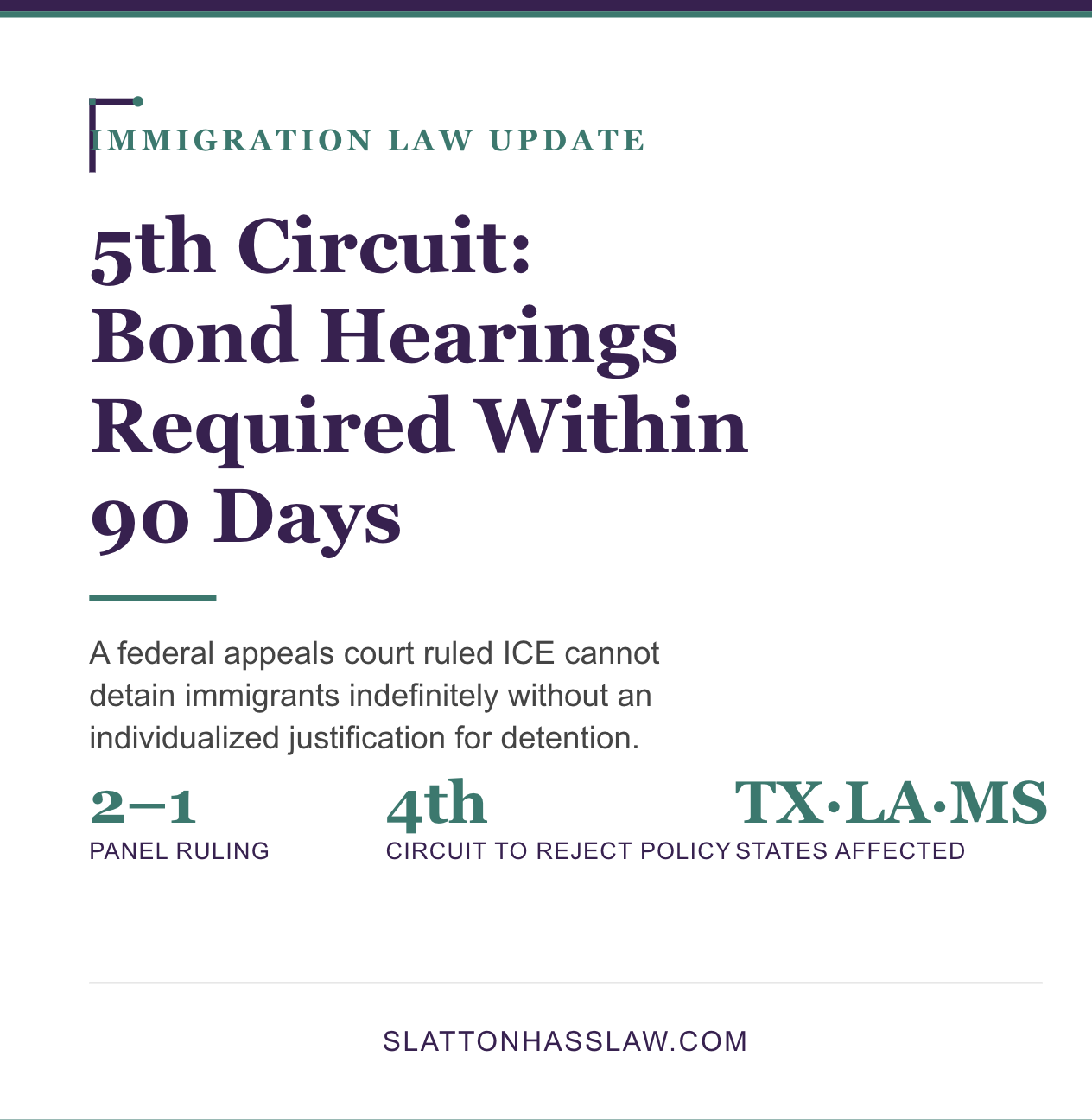
If you have clients sitting in ICE custody in Texas, Louisiana, or Mississippi with no bond hearing in sight, this week's Fifth Circuit ruling matters to you. Here's what happened and what to do next.
What the Court Actually Said, in Plain English
On July 2, 2026, a three-judge panel of the Fifth Circuit ruled 2-1 that the government cannot hold someone in immigration detention indefinitely without ever explaining to a judge why that person needs to stay locked up.
Under immigration law, people classified as "applicants for admission" can be held in mandatory detention while their case moves through immigration court, with no bond hearing at all. That category was always understood to mean people arriving at the border. Last year, DHS decided it should also cover people who already live in the United States, even if they've been here for years. The Board of Immigration Appeals adopted that position in September, and immigration judges started applying mandatory detention across the board.
The result: people with deep roots in the U.S., no criminal record, and U.S. citizen kids were getting picked up on routine traffic stops and held with no path to a bond hearing.
The Fifth Circuit said no. The court held that the Constitution doesn't allow the government to detain someone for an indefinite, extensive period without an individualized determination that detention is actually justified. Practically, that means:
A bond hearing must happen within 90 days of the start of detention.
At that hearing, the government has to give an individualized reason why this specific person should stay detained. It can't just say "you entered the country illegally at some point" and leave it there.
The case involved three men arrested during traffic stops in Texas between November 2025 and February 2026, all long-term residents with U.S. citizen children. Judge Southwick wrote the majority opinion, Judge Graves concurred but said even 90 days is too long, and Judge Wilson dissented, arguing the majority is overstepping into territory the Constitution reserves for Congress.
Practical Implications: What Can People Expect?
A hard deadline now exists in the Fifth Circuit. Clients detained under the expanded mandatory detention policy have a concrete number to point to: 90 days. Before this ruling, many were stuck in limbo with no forum to even raise the question.
This is a panel decision, not final. The government can ask for rehearing en banc (the full Fifth Circuit) or seek Supreme Court review. Until and unless that happens, this is binding law in Texas, Louisiana, and Mississippi. Don't tell clients this is permanently settled. It may not be.
The ruling doesn't require an individual habeas petition for every person. The court was explicit that this isn't meant to force everyone into filing separate habeas litigation just to get a hearing. That's meaningful given the volume: nationally, more than 58,000 detainees have filed habeas petitions challenging their detention, with a large share in Texas courts. This ruling is aimed at reducing that flood, not adding to it.
A circuit split is developing. This is now the fourth federal appeals court to reject the government's position. Two circuits have upheld it, and one remains divided. That split increases the odds of eventual Supreme Court involvement, so build that uncertainty into your client conversations and case strategy.
The 90 days is a ceiling, not a guarantee of release. Winning a hearing at day 90 doesn't mean your client walks out. It means the government has to actually justify continued detention with individualized facts, rather than relying on entry status alone. Immigration judges will still be weighing flight risk and danger to the community.
How Other Attorneys Should Proceed
Audit your detained caseload now. Identify anyone approaching or past 90 days in detention without a hearing scheduled. This ruling gives you a concrete argument to demand one.
Distinguish your clients' fact patterns from the border-arrival cases. The court preserved mandatory detention without a hearing for people recently arriving at the border. Your strongest arguments apply to clients with established ties inside the U.S., long residence, family, work history, and no serious criminal record.
Cite Buenrostro-Mendez v. Bondi and this new decision together. The earlier February panel decision upheld the government's statutory interpretation but didn't reach the due process question. This ruling fills that gap. Frame your filings around both: the statute may permit mandatory detention, but the Constitution still requires a hearing within 90 days.
Prepare for the government to seek rehearing or stay pending appeal. Don't assume this ruling is stable. Keep clients informed that the government may ask the full Fifth Circuit or the Supreme Court to intervene, and that the practical effect on the ground could shift.
Watch how ICE and immigration judges implement this operationally. There will likely be inconsistency in the early weeks as the ruling filters down to detention facilities and immigration courts. Document any case where a hearing isn't held within 90 days despite this ruling, since that record will matter if you need to seek emergency relief.
Coordinate with organizations already litigating this. The American Immigration Council and National Immigration Project argued the underlying case and are tracking implementation. If you have clients in similar situations, connecting with them may help you access resources, template filings, or amicus support.
Don't overpromise to clients or families. This is genuinely good news, but it's a hearing right, not a release guarantee, and it's still subject to further appeal. Set expectations accordingly.
Bottom Line
For the first time, detainees in the Fifth Circuit have a clear, enforceable 90-day deadline for a bond hearing, and the government now bears the burden of individualized justification rather than relying on categorical detention. It's a meaningful shift, but the fight isn't over. Expect further appellate activity, and use this window to get hearings scheduled for clients who have been waiting.
This post is for general informational purposes and does not constitute legal advice for any specific case.
