
What the New USCIS Evidence Rules Mean for Your Case
USCIS has updated how it reviews evidence. The change is mostly about process, not the law, but it matters: a complete, well-documented filing counts more now than it used to.
This post is general information, not legal advice.
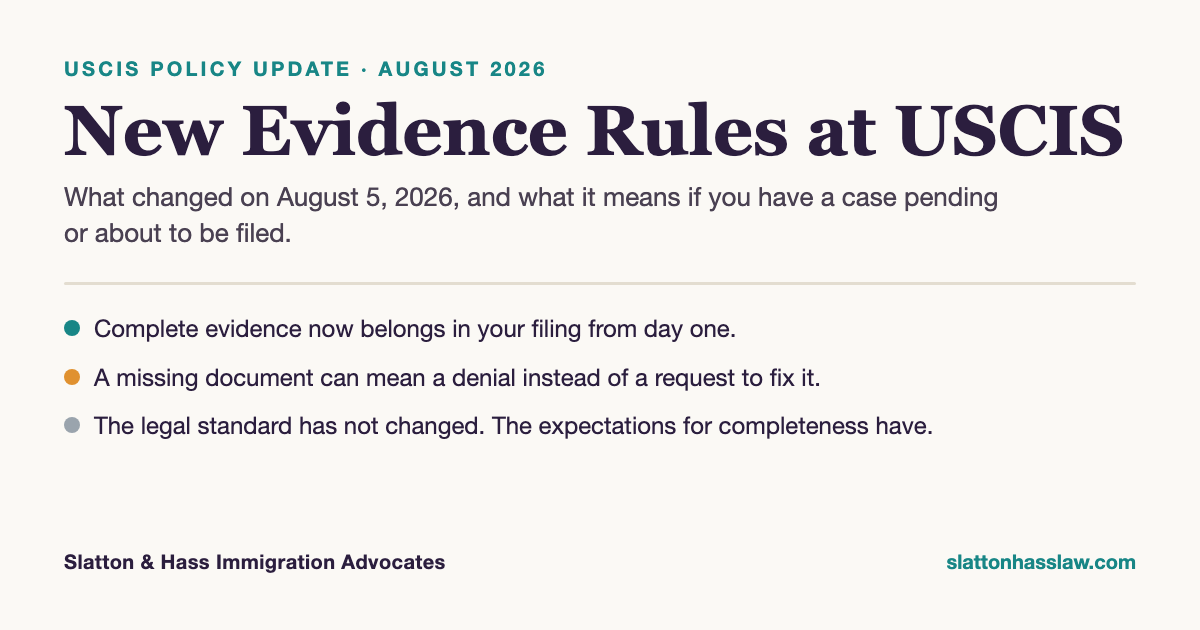 >
>On August 5, 2026, USCIS issued a policy update, known as PA-2026-05, that changes how officers handle evidence, Requests for Evidence, and Notices of Intent to Deny. It took effect the same day and applies to cases that were already pending as well as those filed on or after that date. The shift is more about process than about the law itself, and it is worth understanding clearly rather than anxiously.
The biggest change is that an officer can now deny a case without first asking for more evidence. Two tools are involved. A Request for Evidence, or RFE, is a letter asking you to send something that is missing or to strengthen what you already provided. A Notice of Intent to Deny, or NOID, is a warning that the officer is leaning toward saying no, along with a final chance to respond. For years, an incomplete filing usually meant one of those letters and an opportunity to fix the problem. Under the new guidance, if the required initial evidence is missing, or if what you submitted does not show that you qualify, the officer may simply deny the case.
That puts the focus on what USCIS calls initial evidence. Every type of filing has a list of documents required by the statute, the regulations, and the form instructions. The update reinforces that those documents belong in your initial package, not later. Primary evidence comes first, such as a birth certificate or a marriage certificate. If a primary document genuinely does not exist or cannot be obtained, you can explain why and provide secondary evidence or sworn affidavits instead, but you have to show that the primary evidence was truly unavailable.
The responsibility to prove eligibility stays with you throughout. You have to establish that you qualify when you file, and continue to qualify while the case is being decided. That has always been the rule. The update simply enforces it more strictly.
A few timing details are also worth knowing. The maximum time to respond to an RFE is still 84 days, and a NOID is still 30 days, but officers can now set shorter deadlines. The extra two weeks that used to be added for notices mailed outside the United States has been removed. And if you send only part of what was requested, USCIS will generally treat that as a request to decide the case on the record it already has.
It helps to keep this in proportion. The legal standard for most benefits has not changed. Most cases are still decided on a more-likely-than-not basis. What changed is the expectation that your filing be complete and well-supported from the start, and the loss of a near-automatic second chance. It sits alongside a separate May 2026 memo that directed officers to treat adjustment of status as a discretionary benefit and to look more closely at evidence and background checks.
In practice, the takeaway is simple, and it is good practice anyway: file complete. Gather your documents before you submit, not after. Keep primary evidence where you can, and document any gaps honestly. If you already have a case pending, this is a sensible moment to make sure the record is as strong as it can be. If you are getting ready to file, it is worth taking the time to build the package carefully the first time.
None of this is legal advice, and every case turns on its own facts. If you have a filing in progress, or one you are preparing to submit, and you would like a second set of eyes on the evidence before it goes in, we are glad to help. You can book a consultation below.
Slatton & Hass Immigration Advocates is a Maryland-based immigration firm serving Maryland, D.C., and Virginia. This post is general information, not legal advice, and does not create an attorney-client relationship.