
A Pause, Not a Fix: What the Government's Halt on Third-Country Deportations Actually Means
Last week, something unusual happened. The federal government quietly ordered a pause.
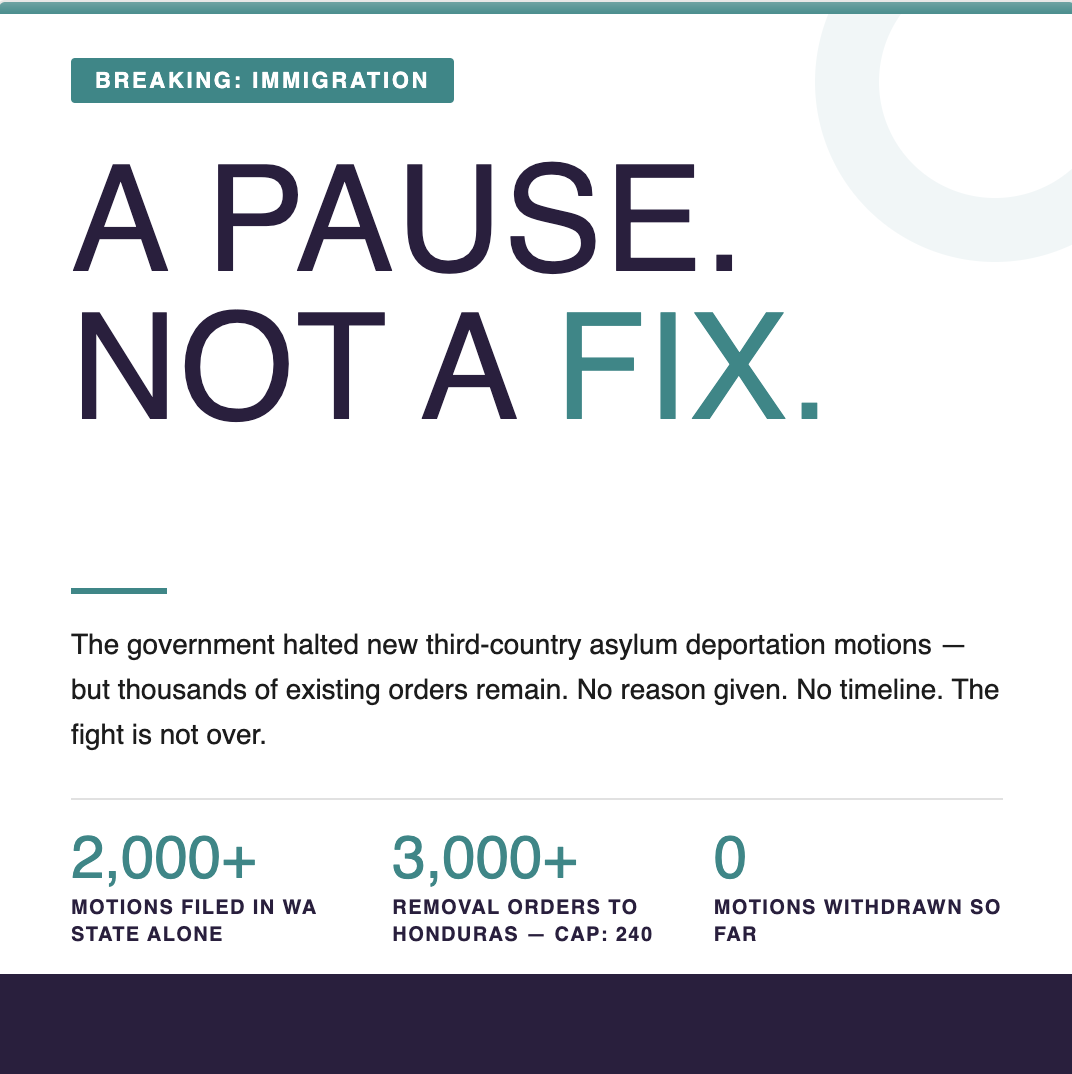
U.S. Immigration and Customs Enforcement lawyers acting as prosecutors in immigration courts received an email directing them to stop filing motions that would send asylum-seekers to so-called "third countries" to pursue their claims for protection. No reason was given. No timeline. Just: stop filing new ones, but keep pursuing the ones already filed.
For anyone who has been watching this practice expand in real time, the pause is notable. But it is not a resolution.
What Has Been Happening
I have written before about pretermission and third-country removal, and I want to revisit it now because the numbers have become impossible to ignore.
In Washington State alone, ICE lawyers filed more than 2,000 pretermission motions, most of them in Seattle's immigration court. Nationally, people have been ordered removed to Ecuador, Guatemala, Honduras, and Uganda, countries where they have no family, no history, and in many cases, no legal right to remain. Honduras has reportedly agreed to accept only 240 people over two years. Yet more than 3,000 removal orders already designate Honduras as the destination.
The math does not work. And the human cost of that gap is enormous.
These pretermission motions cut asylum cases off before they are ever fully heard. No testimony. No evidence. No merits decision. Just a procedural ruling that closes the door before the facts are ever allowed inside.
Why the Pause Happened and Why It Matters
The government's email does not explain the reason for the halt. A legal challenge is pending in federal court in Washington, D.C., and practical obstacles may also be a factor. Some receiving countries have capped the number of deportees they will accept. Others lack the infrastructure to process asylum claims in any meaningful way.
Whatever the reason, the pause reveals something important: this system was not sustainable. It was moving faster than the logistics, the legal challenges, or the receiving countries could absorb.
But a pause is not a rollback. ICE lawyers were told they do not need to withdraw motions already filed. That means thousands of people who already received pretermission orders are still facing removal to third countries where they have no ties and no protection.
Immigration attorneys I respect described these conversations with clients as some of the most devastating of their careers. Telling someone they may have no right to apply for asylum in the United States, without ever getting to present their case, is not a technicality. It is a fundamental denial of the protection our laws were built to provide.
What Has Not Changed
The underlying legal framework that enabled this practice has not been dismantled. The October 2025 Board of Immigration Appeals ruling that accelerated these motions is still in place. The agreements with third countries are still in place. The pause applies only to new filings.
This means practitioners cannot stand down. The work of preservation, documentation, and challenge continues.
If you or someone you know has received a pretermission order or a third-country removal order, options still exist. Appeals to the BIA must be filed. Due process arguments must be preserved. In appropriate cases, federal court review remains available.
The record built at the trial level matters even when a case feels lost. Especially then.
What I Keep Coming Back To
Modern asylum law exists because the world once watched countries close their borders to people fleeing genocide and called it compliance with the rules. The 1951 Refugee Convention and subsequent domestic legislation were built on a specific promise: that legal technicalities would never again be used to turn away people with nowhere safe to go.
What has been happening in immigration courts over the last several months is not a dramatic reversal of that promise. It is a quiet procedural one. And quiet procedural changes are often the most durable.
A pause gives advocates time. It may signal that courts, logistics, or political pressure are creating friction. But it does not mean the system has corrected itself.
Asylum only means something if there is a genuine process to determine who qualifies. That process has to include a hearing. It has to include evidence. It has to include the person.
We are not asking for guaranteed outcomes. We are asking for the most basic thing our legal system is supposed to provide: a fair chance to be heard.
The pause is a moment, not a victory. The fight continues.