
TPS for Haitians: The History, the Current Crisis, and What You Can Do Right Now
Temporary Protected Status for Haiti has been one of the most litigated, extended, terminated, reinstated, and politically contested immigration designations in American history. If you are Haitian and you or someone you love has TPS, or had it, or is trying to understand whether it still applies, this post is for you.
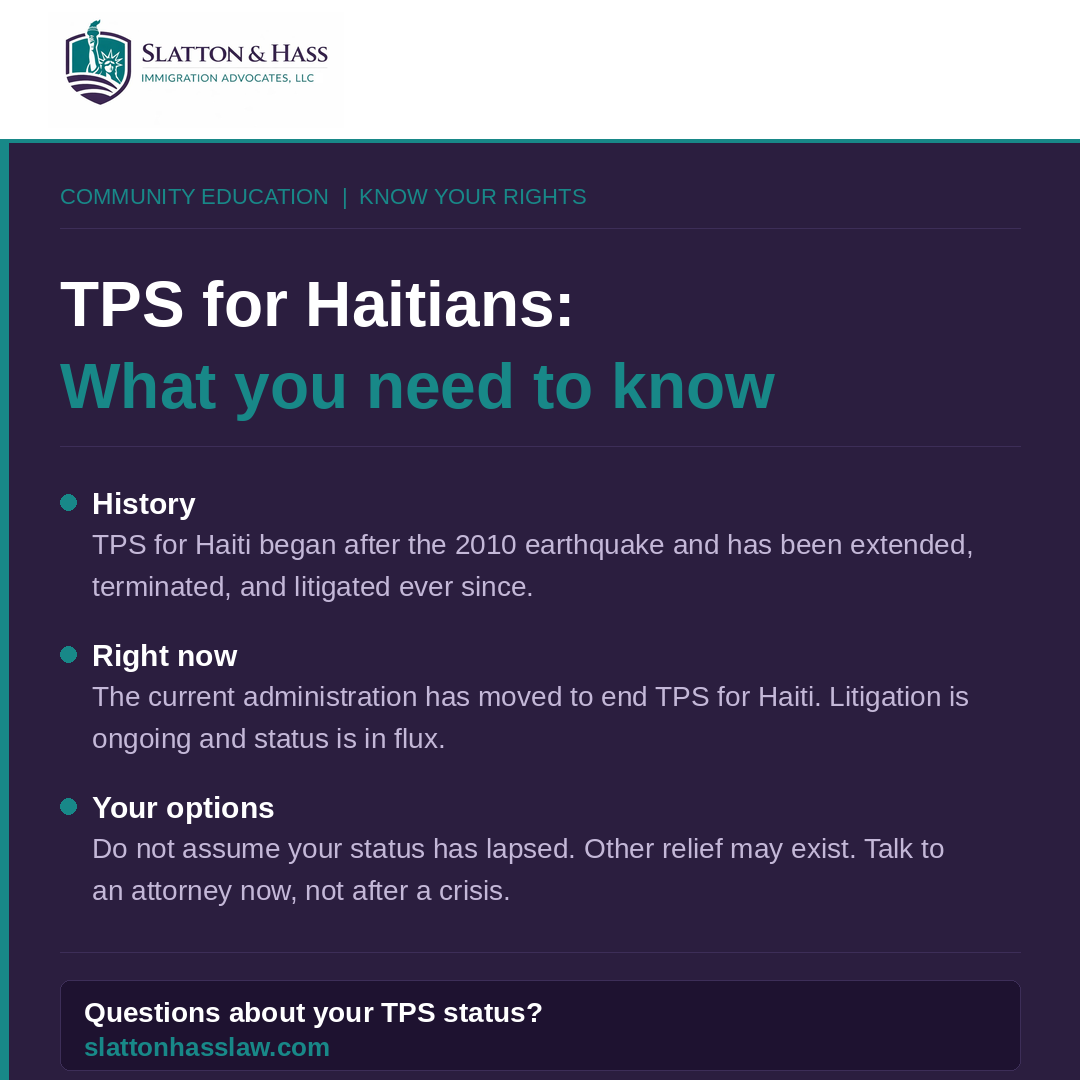
What Is TPS and How Did Haiti Get It?
Temporary Protected Status is a designation the federal government can grant to nationals of countries experiencing ongoing armed conflict, environmental disaster, or other extraordinary conditions that make it unsafe to return. It is not a path to a green card on its own. It provides protection from deportation and work authorization for as long as the designation is in effect.
Haiti was first designated for TPS on January 21, 2010, following the catastrophic earthquake that killed more than 200,000 people and displaced over a million more. At the time, the designation was widely understood as a humanitarian necessity. Returning people to a country with no functioning infrastructure, no shelter, and a collapsed government was simply not defensible.
Over the following decade, Haiti's TPS designation was extended repeatedly as the country continued to face cascading crises: a cholera epidemic, Hurricane Matthew in 2016, the ongoing collapse of state institutions, and spiraling gang violence that has now made Haiti one of the most dangerous places on earth.
The Termination, the Litigation, and the Chaos
In 2017, the Trump administration announced it would terminate TPS for Haiti, with a wind-down deadline set for July 2019. That decision triggered immediate federal litigation. Advocacy organizations and TPS holders sued, arguing the termination was motivated by racial animus and violated the Administrative Procedure Act.
Federal courts agreed, and the termination was blocked by injunctions that kept Haitian TPS holders protected for years while the cases worked their way through the courts.
In 2021, the Biden administration redesignated Haiti for TPS and extended protections significantly, citing the assassination of President Jovenel Moïse, a major earthquake in August 2021, and the total breakdown of security conditions on the ground. At its peak, hundreds of thousands of Haitians in the United States were covered under TPS.
Then came 2025. The second Trump administration moved quickly and aggressively to terminate TPS for multiple countries, including Haiti. The administration argued that TPS had become a de facto permanent status for populations that had been here for years or decades, and that it was being used as a backdoor immigration benefit not intended by Congress.
Where Things Stand Right Now
The situation is in active flux and anyone telling you they know exactly how it will resolve is not being honest with you.
What is known is this: the current administration has sought to end or severely curtail TPS for Haiti. Litigation is ongoing in multiple federal courts. Some courts have issued injunctions blocking terminations, while others have not. The Eleventh Circuit and other appellate courts are actively hearing related cases.
What this means in practice is that the legal status of Haitian TPS holders is genuinely uncertain right now. Work authorization for some holders may still be valid under auto-extensions tied to pending litigation. For others, status may have lapsed. The answer depends heavily on when your TPS was granted, which litigation applies to your case, and whether you filed timely renewals.
This is not a situation where you should try to figure out your status on your own.
What the Situation in Haiti Actually Looks Like
It is important to say plainly: Haiti is not safe. Gang violence has displaced hundreds of thousands of people within the country. The capital Port-au-Prince is largely controlled by armed gangs. The Haitian National Police have been overwhelmed and outgunned. Kidnappings, killings, and sexual violence are widespread. A Kenyan-led multinational security support mission has made limited progress. The United Nations and international aid organizations have documented conditions that meet definitions of humanitarian crisis by any objective measure.
The argument that it is now safe to return Haitians to Haiti is not supported by the facts on the ground. That does not mean the courts or the executive branch will act accordingly, but it is the reality.
What Haitians Can Do Right Now
If you or a family member has TPS or had TPS, take these steps immediately.
1. Do not assume your status has lapsed without verifying. Auto-extensions tied to litigation may still be protecting your work authorization even if your original EAD expiration date has passed. Check the expiration date on your EAD and then consult an attorney about whether a litigation-based extension applies to you.
2. Gather your documents. Collect every TPS-related document you have: approval notices, EADs, receipts, and any correspondence from USCIS. If you need to prove your status in a traffic stop, at work, or in any other situation, you need to be able to show documentation.
3. Explore every other avenue of relief. TPS is not the only option. Depending on your situation, you may have other paths worth exploring including asylum, withholding of removal, U visa eligibility if you have been a crime victim, VAWA if you have experienced domestic abuse, adjustment of status through a qualifying family relationship, or cancellation of removal if you have been in the United States long enough and meet other criteria. Many Haitians who came here years ago and built lives and families may have options they have never looked into because TPS felt sufficient.
4. Do not accept a deportation order without fighting it. If you receive any notice from immigration, including a notice to appear in immigration court, do not ignore it and do not sign anything without speaking to an attorney first. Signing a voluntary departure or stipulated removal order without understanding what you are signing can permanently bar you from returning.
5. Talk to an immigration attorney now, not when something goes wrong. The time to understand your options is before an enforcement action, not after. A consultation costs far less than a crisis response.
A Note on What Is Coming
The legal landscape for Haitian TPS holders will continue to shift over the coming months. Supreme Court review is a real possibility. Congressional action, however unlikely in the current climate, remains theoretically available. And conditions in Haiti itself, while grim, are not static.
What we know from more than fifteen years of Haitian TPS history is that this community has survived every attempt to end these protections through persistence, litigation, and community organizing. That fight is not over.
If you have questions about your specific situation, our office is here. We serve Haitian clients and we understand both the legal landscape and what is at stake.
Slatton & Hass Immigration Advocates, PLLC 8607 2nd Ave, Suite 405A, Silver Spring, MD 20910 24/7 Emergency Detention Hotline: (240) 891-4343 slattonhasslaw.com
This post is for general educational purposes only and does not constitute legal advice or create an attorney-client relationship.