
Common Misunderstandings About VAWA and Immigration Relief
Violence Against Women Act cases are some of the most misunderstood forms of immigration relief. Many people believe myths about who qualifies, what kind of abuse counts, and what applying really means. These misunderstandings stop people from seeking help even when they may be legally eligible.
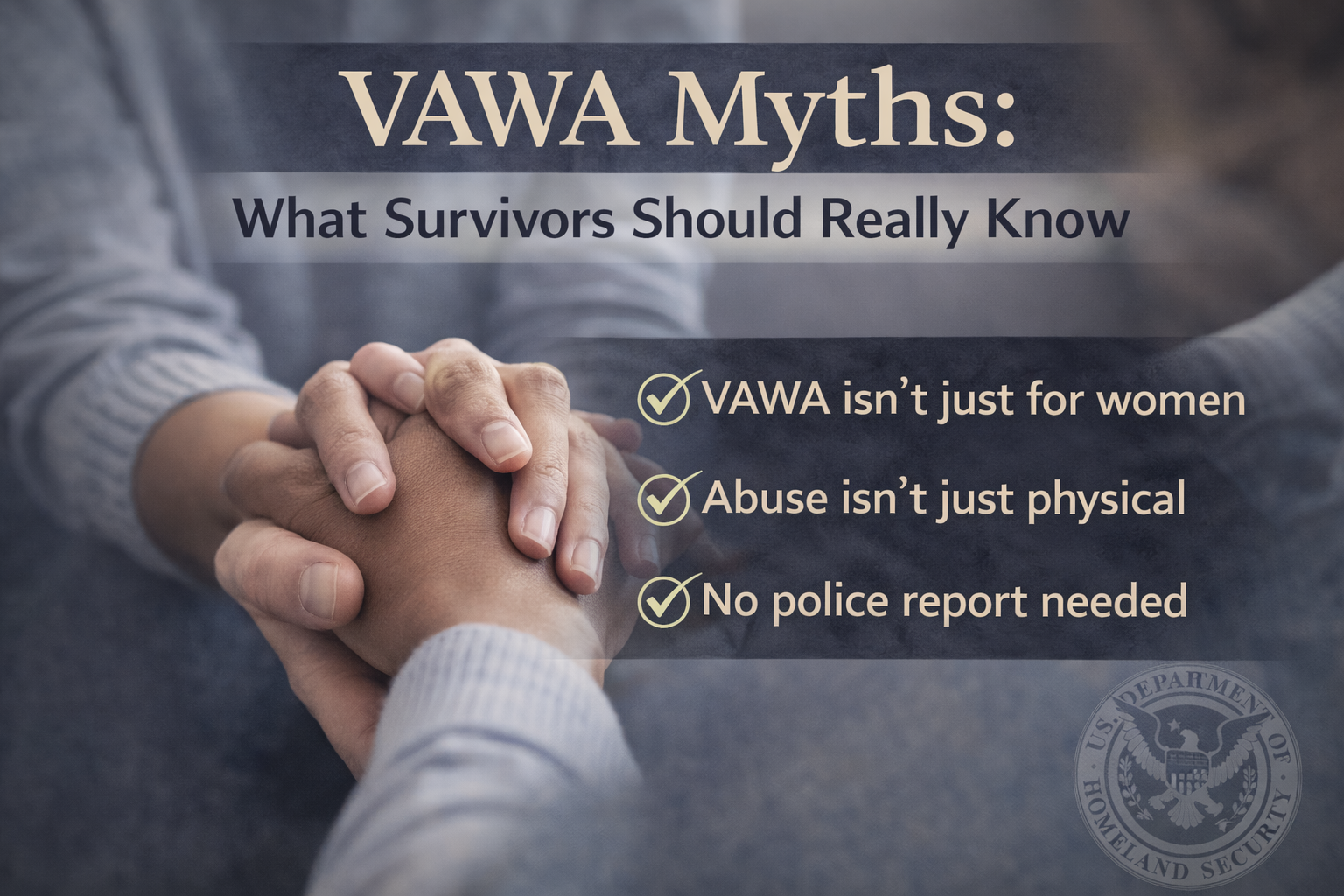
One of the biggest misunderstandings is that VAWA is only for women. Despite its name, VAWA protections apply to all genders. Men, women, and nonbinary individuals can qualify. The law is about protecting victims of abuse, not about gender. If you were abused by a U.S. citizen or lawful permanent resident spouse or parent, or if you were abused as a child by a U.S. citizen or lawful permanent resident parent, you may be eligible regardless of your gender.
Another common myth is that the abuse must be physical. VAWA covers more than just hitting or visible injuries. Emotional abuse, psychological abuse, threats, intimidation, financial control, isolation from family, and immigration related threats can all qualify. Many abusers never leave bruises, but they still control their victims through fear, manipulation, and power. Immigration law recognizes this type of harm as real abuse.
Many people think they need a police report or criminal charges to qualify. This is not true. While police reports and protective orders can be helpful evidence, they are not required. VAWA cases can be proven through personal declarations, witness statements, therapy records, medical records, school records, and other documentation showing the abusive relationship and its impact. The immigration system allows survivors to prove their cases in many ways.
Some people believe they must still be married to their abuser to apply. That is not always true. In many situations, you can apply after divorce if the marriage ended within a certain time frame and the divorce was connected to the abuse. You may also still qualify if your abusive spouse died. Each situation is different, but being divorced does not automatically disqualify you.
Another misunderstanding is that filing a VAWA case will alert the abuser. VAWA cases are confidential. The government is legally prohibited from contacting the abuser or sharing information with them about your application. This protection exists so that survivors can seek safety without fear of retaliation.
Many people think VAWA is only for people with legal status. In reality, VAWA was created specifically to help people who are undocumented or whose status depends on their abuser. You do not need to have legal status to file a VAWA self petition. In fact, many applicants have no status at all when they apply.
There is also confusion about whether VAWA is the same as a U visa or T visa. These are different forms of relief. VAWA is for survivors abused by certain family members who are U.S. citizens or lawful permanent residents. U visas are for victims of certain crimes who cooperate with law enforcement. T visas are for victims of human trafficking. Someone might qualify for more than one type of relief, but they are legally separate programs.
Another myth is that VAWA automatically gives you a green card. VAWA is a pathway, not instant status. It usually involves multiple steps. First, a self petition must be approved. Then the applicant must apply for permanent residence when eligible. This process can take years, but it offers lawful status, work authorization, and a route to a green card without relying on the abuser.
Some people believe applying for VAWA is dishonest or “gaming the system.” This is not true. VAWA exists because Congress recognized that abusers often use immigration status as a weapon. The law is designed to remove that power and protect survivors. Applying under VAWA is using a legal protection that was intentionally created for this exact situation.
Finally, many survivors believe they will not be believed. Fear of not being trusted keeps many people silent. VAWA cases are decided based on credibility, consistency, and evidence as a whole. There is no requirement to prove abuse beyond all doubt. Survivors do not need perfect documentation. They need truthful, detailed explanations and supporting proof where possible.
VAWA is a powerful tool, but only if people understand it. Misinformation keeps survivors trapped in dangerous situations. Knowing the truth about VAWA can mean the difference between staying in an abusive relationship and building a safe, independent future.
If you or someone you know is experiencing abuse and immigration status is being used as a form of control, it is important to speak with an immigration attorney who understands VAWA. Getting accurate legal advice can open doors that fear and misinformation have kept closed for far too long.