
Calls, Mail, and Money: How to Support Someone in ICE Detention
When a loved one is detained by Immigration and Customs Enforcement (ICE), one of the first practical questions families ask is: how do I get them money? How do I make sure they can eat, call home, or buy basic necessities? The answer depends on where your loved one is being held, because immigration detention facilities are not run by one single system. Each facility has its own rules, its own approved vendors, and its own process for receiving funds and communications.
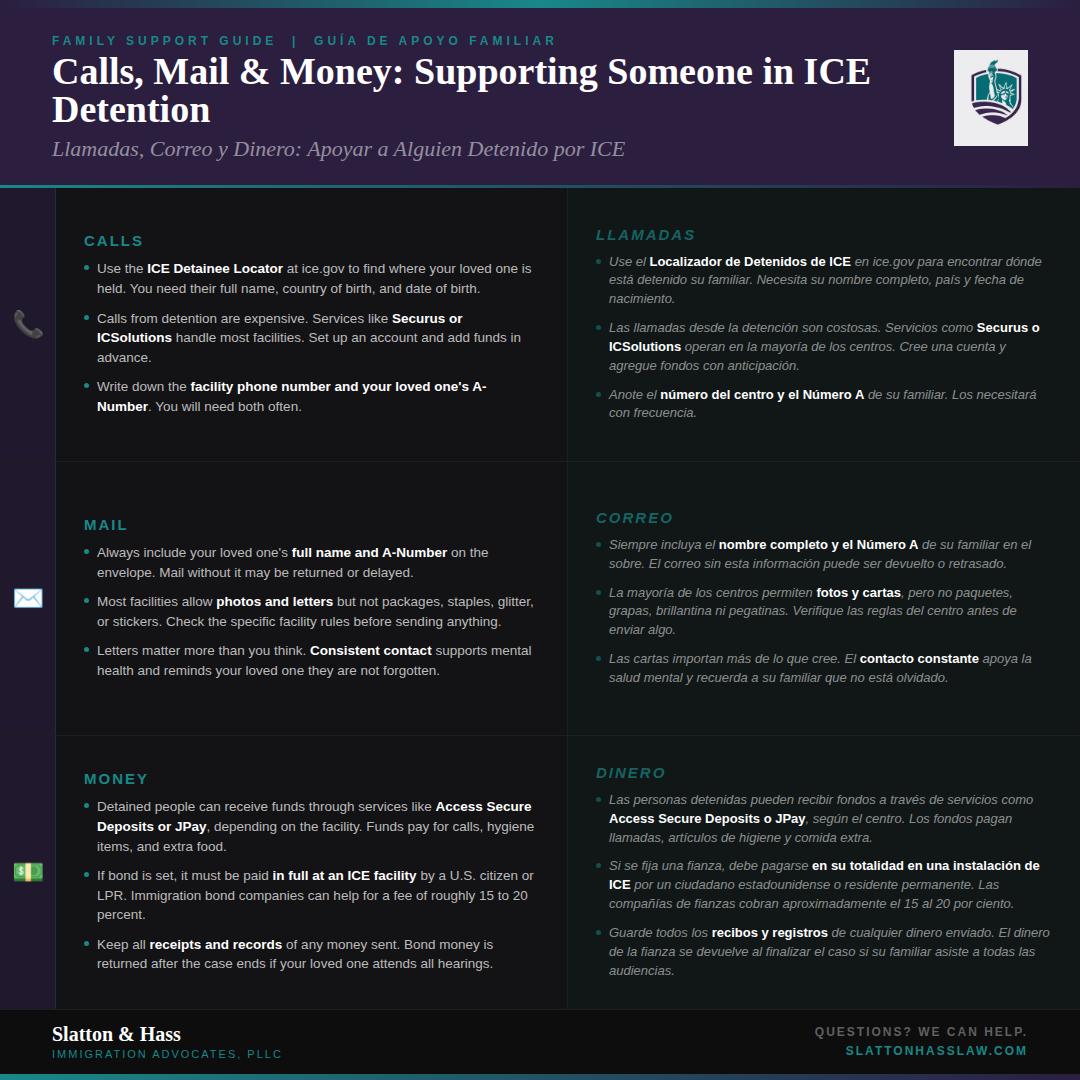
This guide walks you through everything you need to know about supporting someone in immigration detention, from sending money to making phone calls to mailing letters.
Understanding the Detention System
Before anything else, it helps to understand how the detention system is structured. ICE does not operate a single national detention system with uniform rules. Instead, ICE contracts with hundreds of facilities across the country, including county jails, private detention centers, and dedicated immigration processing facilities. Each of these facilities may have completely different systems for phone calls, commissary deposits, visitation, and mail.
This means that the very first thing you need to do before attempting to send money or communicate is identify exactly where your loved one is being held. You can do this by using the ICE Online Detainee Locator at locator.ice.gov, or by contacting an immigration attorney who can help you locate them if they do not yet appear in the system.
Once you know the facility, you will need to look up that specific facility's rules. Many facilities have a website or a detainee information line that can answer basic questions about deposits and communications.
Sending Money to Someone in Detention
Detained individuals are generally allowed to have a small amount of money in a facility account, which they can use to purchase items from the commissary (an internal store where detainees can buy food, hygiene products, phone credits, and other items). Having money in their account is important because commissary access can make a significant difference in their daily comfort and their ability to stay in contact with family and attorneys.
The Most Common Method: JPay and TouchPay
Many immigration detention facilities use third party payment platforms to process deposits into detainee accounts. The two most commonly used platforms are JPay and TouchPay (also called ICSolutions or IC Solutions).
JPay allows you to send money online at jpay.com or through the JPay mobile app. You will need the facility name and the detained person's ID number (which may be their ICE Alien Registration Number or a facility assigned ID). There is typically a transaction fee charged by JPay, which varies based on the amount sent and the facility.
TouchPay and ICSolutions are used at many other facilities. You can make deposits at touchtaypayments.com or through their app, and some facilities also allow cash deposits at kiosk machines located in the lobby of the facility. Again, you will need the facility name and the person's ID number.
Western Union and MoneyGram
Some facilities accept money transfers through Western Union or MoneyGram, directed to the facility on behalf of the detained individual. This method is less common than it used to be, but it is still used at certain facilities. If the facility uses this method, you will be given specific instructions on how to address the transfer.
Facility Specific Accounts
Some facilities, particularly county jails operating under IGSA contracts with ICE, manage their own detainee trust accounts independently and do not use third party platforms at all. In these cases, you may need to send a money order made out to the facility with the detained person's name and ID number written in the memo line. Call the facility directly to confirm the exact process before sending anything.
What Money Can Be Used For
Once funds are in a detained person's account, they can typically be used to purchase food and snacks beyond what is provided at meals, hygiene products such as soap, shampoo, toothpaste, and deodorant, writing materials including paper, envelopes, and stamps, phone credits to make calls to family and attorneys, and in some facilities, access to email or tablet services.
Having commissary money is not a luxury. In many facilities, the standard meals are inadequate, hygiene products are not provided in sufficient quantities, and the ability to make phone calls depends entirely on having credits in your account.
Making Phone Calls
Phone access is one of the most critical lifelines for a detained person and their family. Here is how it typically works.
Most immigration detention facilities contract with a single phone service provider for all calls made from within the facility. The most commonly used providers in the immigration detention system are Securus Technologies and ICSolutions (the same company behind TouchPay for deposits).
Calls from detention are almost always collect calls or calls that require prepaid accounts. This means that the detained person cannot simply dial out freely. There are generally two ways to receive or fund calls.
The first option is to set up a prepaid account with the phone provider so that the detained person can call your number without being charged per call at the time of the call. You deposit money into the prepaid account associated with your phone number, and calls are deducted from that balance.
The second option is to accept collect calls directly, which will be billed to your phone bill. Be aware that the per minute rates for calls from detention facilities are often extremely high, sometimes several dollars per minute, so monitoring your balance or phone bill is important.
To set up an account with Securus, visit securustech.net. For ICSolutions, visit icsolutions.com. Both platforms have mobile apps that make it easier to manage your account and receive calls.
Important Note on Recorded Calls
All calls made from immigration detention are recorded and may be monitored, with one critical exception: calls between a detained person and their attorney are supposed to be confidential and are not supposed to be recorded. When your loved one calls, remind them not to discuss the details of their case over the phone unless they are speaking with their attorney on a designated confidential line.
Sending Mail and Letters
Receiving mail can make an enormous difference in the mental and emotional wellbeing of someone who is detained. Letters from family, photographs, drawings from children, and cards from community members all matter.
Here is what you need to know about mailing to someone in detention.
Each facility has a specific mailing address for detainee mail. Do not send mail to the general facility address without confirming the correct mailing format. Most facilities require that you include the detained person's full legal name and their ID number (often their Alien Registration Number or a facility assigned booking number) on the envelope.
Mail is typically opened and inspected by facility staff before being delivered to the detained person. This is standard procedure and is done for security reasons. Do not include anything inside an envelope that is not permitted, such as cash, gift cards, staples, or certain types of photographs. Check the facility's rules carefully because what is permitted varies widely.
Some facilities have transitioned to scanning incoming mail and delivering it digitally through tablet systems rather than delivering physical mail. In these facilities, your letter will be scanned and the detained person will read it on a screen rather than receiving the physical copy.
Sending Books, Magazines, and Reading Materials
Many detained individuals are desperate for reading material, both for mental stimulation and to help pass the time. However, most facilities have strict rules about how books and magazines can be sent.
The most common rule is that books and magazines must be sent directly from the publisher or from an approved retailer such as Amazon, not from an individual. This means you cannot buy a book at a bookstore and mail it yourself. You must order it and have it shipped directly from the retailer to the facility address. Always confirm this rule with the specific facility before ordering.
Some facilities prohibit books entirely or restrict the number of books a detainee may have in their possession at one time.
Email and Digital Communication
A growing number of immigration detention facilities now offer email and digital messaging services through platforms such as JPay or CorrLinks. These services allow family members to send and receive messages electronically, often at a lower cost than phone calls and with less delay than physical mail.
To use these services, both the detained person and the family member must typically create an account on the platform and be connected through the facility's system. The detained person may need to initiate the connection from their end first. Check whether the facility uses an email platform and set up an account as soon as possible if it is available.
Keep in mind that all electronic messages are also subject to monitoring and review in the same way that phone calls are.
Visitation
In person visitation policies vary dramatically from facility to facility. Some facilities allow contact visits where you can sit in the same room as your loved one. Others allow only non contact visits through glass with a phone. Some facilities have suspended or severely restricted visitation in recent years.
Before attempting to visit, you must confirm that the facility allows visitation and understand their specific process. Most facilities require that visitors be on an approved visitation list, that visitors present valid government issued identification, and that visits be scheduled in advance, sometimes days ahead.
If you have immigration concerns yourself, be aware that ICE has historically had a policy against arresting individuals at or near sensitive locations, though enforcement priorities have shifted in recent years. Consult with an attorney before visiting a detention facility if you have any concerns about your own status.
What Attorneys Can Do That Families Cannot
It is worth noting that immigration attorneys have tools and access that family members do not. Attorneys can often locate detained individuals more quickly through direct communication with ICE and through legal databases. Attorneys can make confidential calls that are not recorded. Attorneys can file emergency motions to prevent transfers or to challenge conditions of detention.
If you do not yet have an attorney, finding one should be your first priority alongside the practical steps outlined in this guide.
A Note on Nonprofit Organizations and Bond Funds
Several nonprofit organizations work specifically to support detained immigrants and their families. Some of these organizations operate bond funds that can help pay immigration bonds for qualifying individuals. Others provide free or low cost legal representation, help families navigate the deposit and communication systems, and offer direct support to detained individuals.
Organizations operating in the DMV region include the Capital Area Immigrants' Rights (CAIR) Coalition, CLINIC (Catholic Legal Immigration Network), and several others. A full list of free and low cost legal service providers is typically posted within detention facilities, though as noted earlier, these lists are not always current.
A Word on Your Own Wellbeing
Supporting a detained loved one is exhausting, expensive, and emotionally draining. The systems are deliberately difficult to navigate. The fees are high. The information is hard to find. None of that is an accident.
Give yourself grace as you figure this out. Ask for help from community members, from nonprofit organizations, and from legal advocates. You do not have to navigate this alone.
Final Thoughts
Sending money, making phone calls, writing letters, and arranging visits are all acts of love and resistance. They keep your loved one connected to the outside world during one of the most frightening experiences a person can go through. Understanding how the system works is the first step toward making sure your loved one knows they have not been forgotten.
At Slatton & Hass Immigration Advocates, we work with detained individuals and their families throughout the DMV region and nationwide. If your loved one has been detained by ICE, contact us. We can help you locate them, connect you with the right resources, and begin building a legal strategy from the very first call.
This blog post is for educational and informational purposes only. It does not constitute legal advice and does not create an attorney-client relationship. Immigration law is complex and fact specific. Please consult a licensed immigration attorney for advice regarding your specific situation.